
Background
-
As research and practice in the electricity market deepen, the importance of power system ancillary services for system security has attracted increasing attention. The most severe fault that may occur during power system operation is a complete system shutdown. Once the entire system loses power, the ultimate safety measure of the power system is how to quickly restore the system and supply power to users. In recent years, several major blackout incidents worldwide have reminded us that studying the post-fault restoration of power systems, namely the black start service issue, is of significant theoretical and practical importance.
-
A so-called black start refers to the process in which, after the entire system shuts down due to a fault and the system experiences a complete power loss (not excluding that isolated small grids may still remain operational), it is in a fully "black" state and, without relying on the help of other networks, starts up through generating units in the system that have self-start capability, drives generating units without self-start capability, gradually expands the system restoration scope, and ultimately achieves the restoration of the entire system.
Station-Wide Black Start Solution
2.1 Remote Black Start Solution
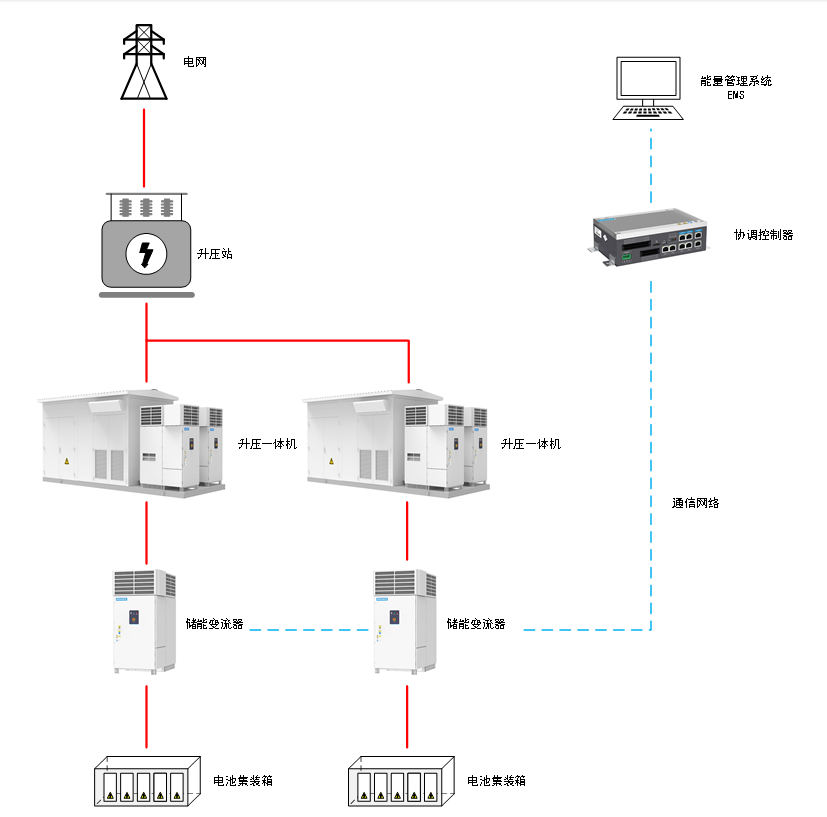
When the station grid loses power, the battery and PCS need to operate to drive the station loads, as shown in Figure 1. Before the black start, close the switches of each box-type transformer and the main transformer, and the PCS performs a zero-voltage rise to drive the station transformer and other loads; since the capacity of the station main transformer and other loads is relatively large, the required excitation current is also relatively large, therefore PCS units under one busbar or multiple busbars in the station need to perform a zero-voltage rise simultaneously. The operation flow chart is shown in Figure 2.
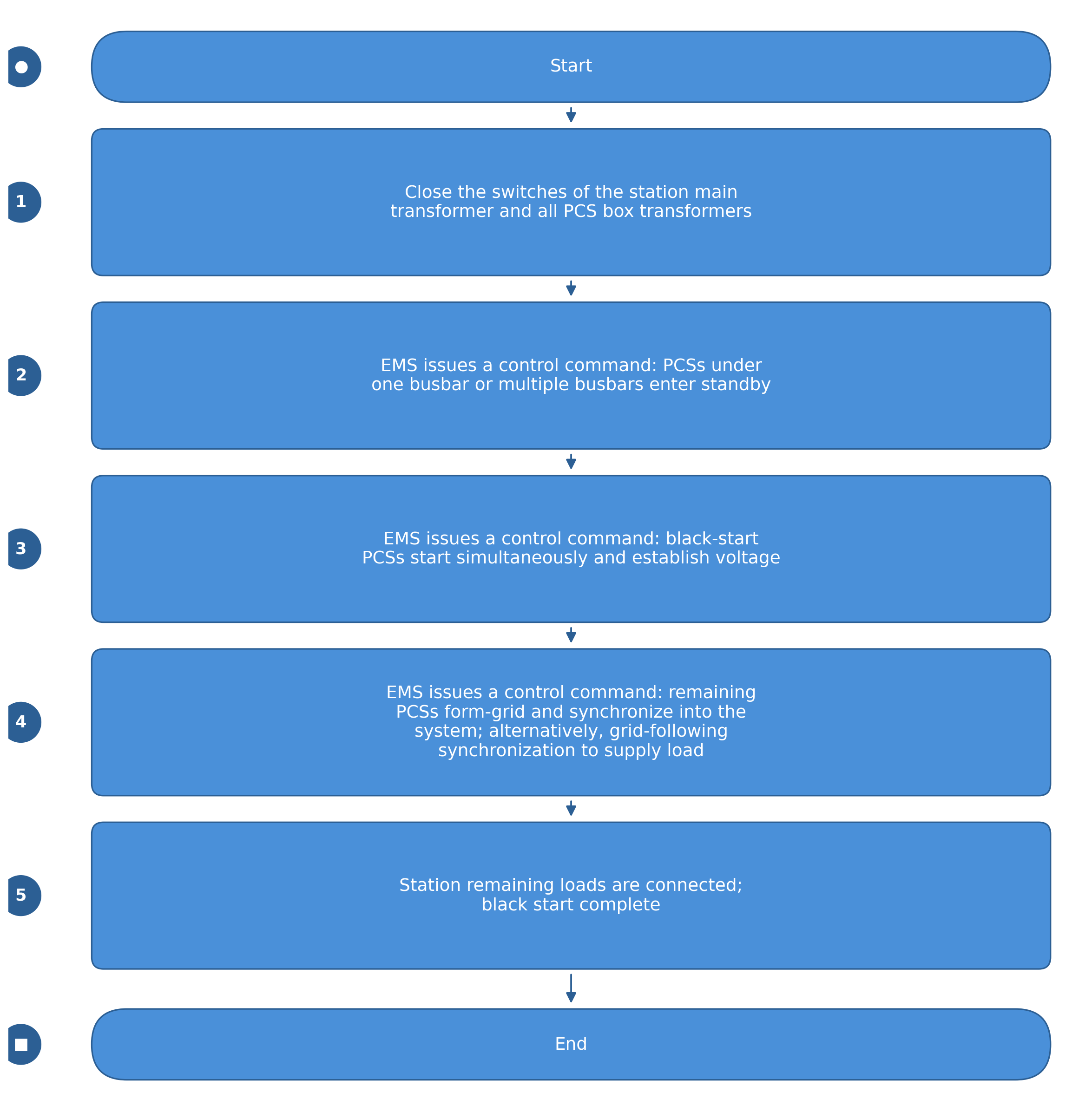
As shown in Figure 2, after the PCS voltage is established, the remaining loads in the station can be put into operation in order of importance until the black start of the entire station is completed.
The advantage of the zero-voltage rise scheme in this solution is that the excitation current of the transformer rises slowly, resulting in a smaller impact on the transformer and PCS; the zero-voltage rise scheme places high requirements on the PCS communication network, and the synchronization error of the start commands received by each PCS should be less than 3 ms, to prevent excessive phase angle differences during the off-grid voltage establishment process of each PCS from causing system instability.
2.2 Local Black Start Solution
Considering the most severe operating conditions of the station, the entire station loses power completely (UPS has no power, no diesel generator). At this time, the communication system is paralyzed, and remote black start cannot be performed. The PCS needs to start locally after the battery is powered on, and other PCSs and loads are connected in sequence. The operation flow chart of the local black start is shown in Figure 3.
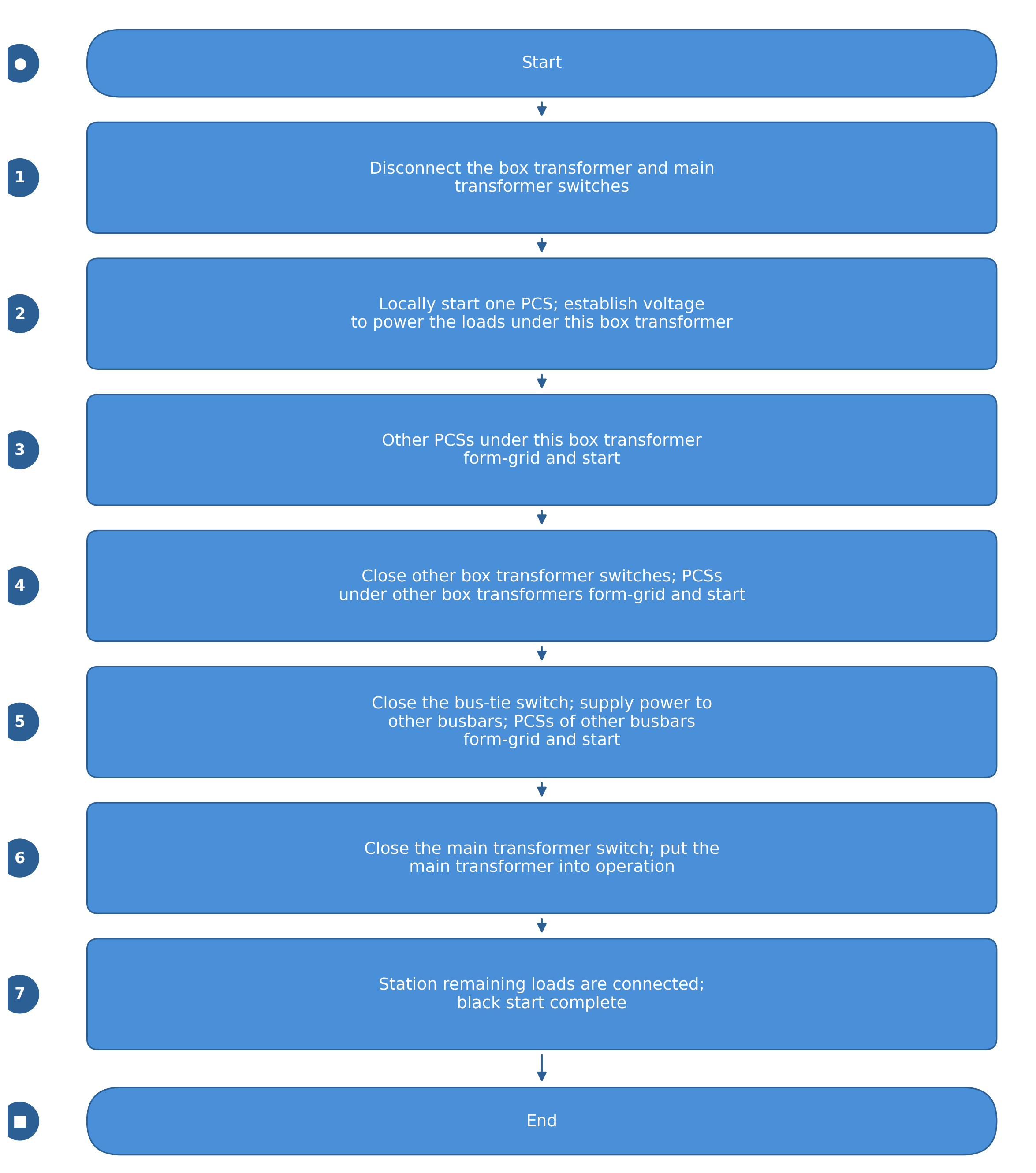
As shown in Figure 3, since the station has no communication, only one PCS can be started locally first; the load-carrying capability of a single PCS is limited, so the main transformer switch and the high-voltage side switches of other box-type transformers need to be disconnected before startup. After a single PCS establishes the voltage, other PCSs under the same box-type transformer can form a grid and synchronize in to improve the load-carrying capability. When all PCSs on the entire busbar have successfully formed a grid and started, the bus tie switch can be closed to start PCSs under other high-voltage busbars. After PCSs under other busbars have started, the main transformer switch can be closed and other loads in the station can be connected.
The advantage of the station-wide local black start method is that it has low requirements on communication and can even start under conditions without communication; the disadvantage is that the transformer and other station loads need to be switched in with no load, resulting in a large inrush current, which has a significant impact on the PCS and transformer. The grid-forming converter of our company can be used to enhance the impact resistance of the PCS. At the same time, compared with the remote black start, the startup speed of the local black start is also relatively slow.
3 Summary
In response to the station-wide black start issue, our company has proposed two solutions: remote black start and local black start. The remote black start is suitable for conditions where the station UPS and communication system still have power, and it places high requirements on the consistency of station communication; the startup speed of the remote black start is relatively fast, and the impact on the transformer and PCS is relatively small. The local black start is suitable for the application scenario where the entire station is in a fully "black" state, with a slower startup speed and a greater impact on the transformer and PCS.